You are on our wealth management services website for advisors & wealth managers.
Browse more Fidelity websites here.
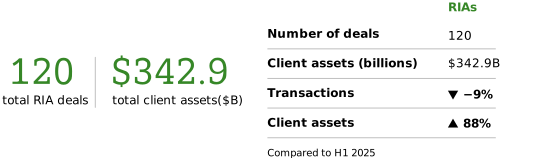
The first half of 2026 continued to show strong M&A activity within the RIA industry. While the number of reported transactions declined slightly to 120 deals from 132 in the first half of 2025, the scale of acquisitions expanded dramatically. Aggregate acquired assets reached $342.9 billion, nearly doubling the $182.8 billion reported a year earlier.
H1 2026 wealth management M&A transaction overview
This growth was fueled by several marquee transactions, including:
As a result, median deal size increased from $517 million to $630 million, and transactions involving firms with more than $1 billion in assets rose 6% year over year as these firms see high demand due to their experience and demonstrated ability to grow. Notably, deal activity remained remarkably consistent throughout the first half of the year, with three separate months recording exactly 17 transactions.
By contrast, no broker-dealer M&A transactions were reported during the period, highlighting ongoing consolidation and a potentially shrinking pool of acquisition targets within the broker-dealer market.
M&A activity in the first half of 2026 highlights an industry that is not merely growing through acquisition but continuing to evolve. Demographic pressures, including an aging advisor population, remain a key driver of succession-related transactions, while the abundance of private equity capital continues to fuel robust deal activity. At the same time, strategic acquirers are increasingly using M&A to expand capabilities, deepen expertise, and enhance client offerings rather than simply increase assets under management.
As we noted in our "2025: A Year in Review" report, wealth management M&A has firmly entered its second chapter, one defined by the evolution of firms from traditional advisory practices into sophisticated, diversified financial services enterprises. That transformation has accelerated in 2026.
As we look across the M&A landscape, we see that:
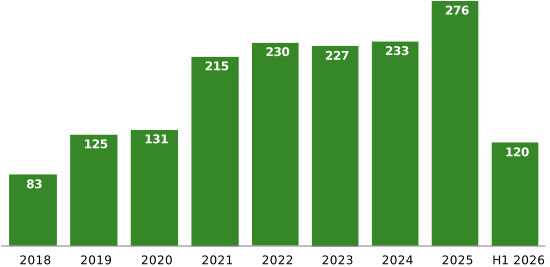
In this report, we will examine the trends and statistics shaping the fast-moving M&A landscape in H1 2026. To provide additional perspective, the report also features spotlight interviews with Annie McCauley, president of Sequoia Financial Group, and Kurt Miscinski, CEO of Cerity Partners.
Through these conversations, along with our analysis of 2026 M&A activity to date, we see firms creating durable growth platforms with these interconnected priorities:
But first, let’s take a closer look at the numbers.
Options abound for RIAs and adjacent businesses
Strategic acquirers accounted for 82% of the total transactions in H1 2026, up from 78% in H1 2025.
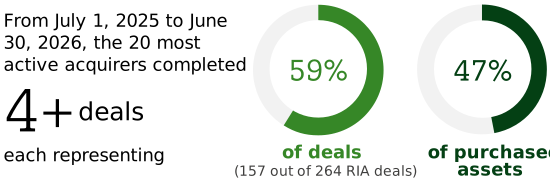
To gain deeper insight into the forces shaping dealmaking behavior, we narrowed our analysis to the top 20 most active acquirers.
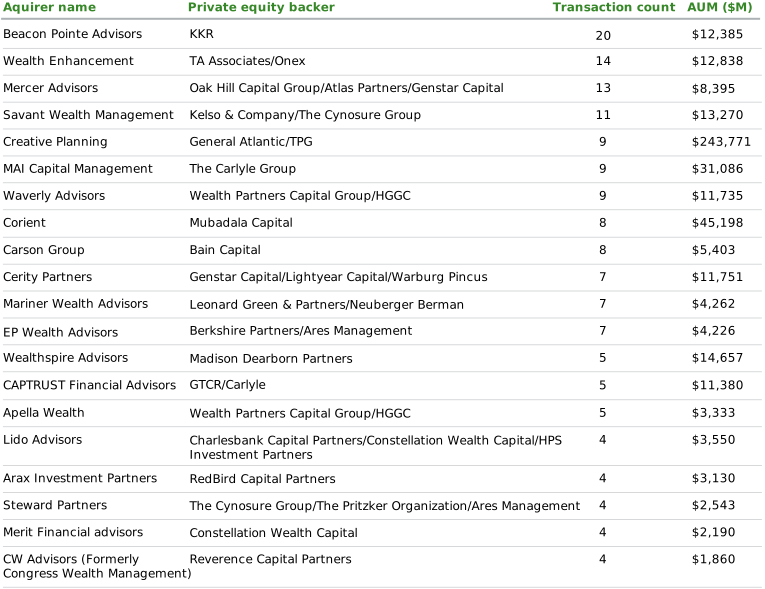
Source: Fidelity M&A Transaction Reporting. Fidelity compiled this data from public information. M&A activity from July 1, 2025, to June 30, 2026.
In the first half of 2026, five firms completed five or more transactions, ten firms executed three to four deals, and eight firms closed two acquisitions each. Savant Wealth Management was the most active acquirer, completing nine acquisitions, followed by Beacon Pointe Advisors with eight. Notably, Savant completed only three acquisitions annually in both 2024 and 2025, highlighting a significant increase in deal activity during the current period. Wealth Enhancement, Cerity Partners, and Mercer Advisors also remained active buyers, each completing five acquisitions. The ongoing success across the strategic acquirer space highlights the importance of offering a broad range of business models, financial options, and cultural fits allowing firms seeking potential suitors to find the best fit for their founders, staff, and clients.
Additionally, 12 RIA adjacent business acquisitions were reported in H1 2026, highlighting the ongoing Chapter 2 movement of firms from traditional advisory practices into complex financial services enterprises. Cerity Partners and Waverly Advisors were the most active participants, completing two transactions each. Approximately one-third of these deals involved the acquisition of tax and accounting firms. Seven transactions involved U.S.-based RIAs acquiring firms outside the United States. Corient and Creative Planning led cross-border activity, with two transactions each. The market also saw 13 first-time acquirers in H1 2026, compared with 16 new entrants during the same period in 2025, showing there’s still opportunities for new players to emerge in wealth management M&A.
Notably, 22 minority-investment transactions were announced during H1 2026, with the most active investors including Elevation Point with three investments and Emigrant Partners, Accelerated Wealth Partners, and Merchant with two investments each.
PE-backed or PE-owned buyers were responsible for 107 of 120 transactions (89%) in the first half of 2026, up from 113 of 132 deals (86%) in H1 2025. The sustained presence of PE-backed acquirers underscores the continued influence of institutional capital in driving consolidation, funding growth strategies, and supporting large-scale M&A programs across the wealth management landscape.
We have observed that the percentage of deals backed directly or indirectly by PE has hovered between 86% to 89% from 2024 through H1 2026. It remains to be seen how long this level of PE activity will continue, and how the industry reacts to changes in market dynamics. For the moment, private equity remains a dominant force in the RIA acquisition market providing capital and strategic support to the industry's most active acquirers.
To better understand how leading acquirers are navigating growth, integration, and scale, we spoke with Annie McCauley, president of Sequoia Financial Group. Her perspective offers insight into how one of the industry's most active buyers approaches M&A while maintaining a strong focus on culture, client experience, and long-term sustainability.
Sequoia’s growth strategy is guided by a clearly defined mission: “to enrich lives through planning that endures.” Under McCauley’s leadership, expansion is not viewed as growth for growth’s sake, but as a way to serve more clients and build a durable enterprise. “There’s demand because of the work we do,” she says. “So our goal is to capture that need. Let’s go help more people.”
That philosophy extends directly to the firm’s M&A strategy. While many buyers focus primarily on accumulating assets or EBITDA, Sequoia evaluates opportunities through the lens of culture and long-term vision. “Anybody can roll up EBITDA; from our perspective, that’s not necessarily interesting or fun,” McCauley says.

Finding great firms that are aligned on people-first culture that want to build something great together, that’s really what integration has always been about for us. We want to be the firm of choice for founders who care deeply about the future for their clients and their team.”
Annie McCauley, president, Sequoia Financial Group

Culture remains the foundation of Sequoia’s approach. McCauley notes that the firm’s core values have remained remarkably consistent throughout her 26 years with the organization. “We always say, set aside your ego and just collaborate for the benefit of the client,” McCauley explains. “How do we together leverage the talents of the team, support each other to do great work for our clients, and always keep the client first?”
Rather than treating acquisitions as one-way integrations, Sequoia views them as opportunities to improve the broader organization. The firm actively incorporates ideas from acquired partners, often adopting practices that enhance advisor productivity or client outcomes. Following the acquisition of Carlson Capital Management, for example, Sequoia is adopting a more effective client balance sheet process. “It’s different and it’s better,” McCauley says of the new process. “The hard part about good ideas is once you hear them, you can’t unhear them.” The same mindset has led Sequoia to scale specialized estate-settlement processes and other client service innovations introduced by acquired firms.
Several acquisitions have been particularly transformative. The acquisition of Affinia Wealth Management reinforced Sequoia’s belief that part of the future of wealth management lies in specialization and hyper-personalization, helping the firm better serve niches such as public-company executives, first responders, and business owners. Affinia brought a depth and breadth of experience bringing families customized special needs financial planning. Other integrations have brought in experience such as a focus on public-company executives, physicians, and first responders, to complement Sequoia’s long history of working with business owners. Likewise, the acquisition of Zeke Capital accelerated the development of Sequoia Sentinel, the firm’s family office offering, as well as significantly expanding its investment and alternative investment capabilities. More recently, acquisitions such as All Star Financial have supported Sequoia’s effort to scale in-house tax services while bringing in teams that fit culturally. “They’ve got wealth, they’ve got tax, and most importantly, they’ve got culture,” McCauley says. “They’re just great people who love taking care of their clients.”
Today, Sequoia’s growth engine extends well beyond acquisitions. The firm targets total annual growth of approximately 40%, including 25% from M&A and 15% from organic growth. For McCauley, organic growth serves as a critical validation metric. “If you’re not out there really testing the marketplace every day and winning new business, you don’t really know if you’re on the top of your game,” she says. Approximately half of Sequoia’s organic growth continues to come from client and COI referrals, reflecting the strength of its client experience and advisor relationships.
As the organization has expanded nationally, Sequoia has invested heavily in advisor development, integration, and employee engagement. One of the firm’s most important growth metrics is not financial at all. “One of our most important growth metrics is our employee engagement scores,” McCauley says. “We have to grow at a pace that keeps our culture engaged and creates opportunity for our team members.” The firm tracks engagement through annual surveys, customizes development programs for advisors who join through acquisitions, and maintains direct feedback loops through leadership outreach and onboarding initiatives.
Technology and AI are also becoming increasingly important enablers of scale. Sequoia measures technology adoption through a proprietary “digital quotient” framework and is deploying AI-powered tools to streamline workflows and improve advisor efficiency. For McCauley, the goal is not replacing advisors but empowering them.

How do we create capacity for our advisors to get things done faster so that they can spend more time thinking and speaking with clients and less time aggregating information, creating reports, and processing workflows?”
Looking ahead, McCauley expects industry consolidation to continue, potentially culminating in larger mergers among leading RIAs. She believes the future belongs to firms that combine scale and brand recognition with highly personalized service. “The future of the industry is the hyper-personalization of the client experience powered by national brand,” she says.
Through it all, Sequoia remains grounded in what McCauley sees as the true purpose of wealth management. “We are not in the business of just getting big for the sake of getting big,” she says. “We’re in the business of expanding our scale so we can help more people.” That philosophy continues to shape every acquisition, integration, and growth initiative across the firm.
When Kurt Miscinski looks back on the origins of Cerity Partners, he sees a moment of disruption that created an opportunity to rethink an entire industry. Emerging from the global financial crisis, he recognized that wealthy families were no longer satisfied with fragmented advice delivered by disconnected specialists. They wanted something more integrated, more trusted, and fundamentally more aligned with their interests.
“Coming out of the global financial recession, a lot was rapidly changing in our industry,” Miscinski recalled. He observed that clients often found themselves juggling accountants, attorneys, insurance professionals, bankers, and investment advisors, all providing guidance from their own perspectives. The challenge, he said, was that important financial decisions rarely exist in isolation. “It’s difficult to make an investment decision without knowing the context of, does this align with my estate plan? Does this make sense from how it might be taxed?”
That realization became the foundation for Cerity Partners. Rather than building another advisory firm, Miscinski envisioned a multidisciplinary professional services organization modeled after the great accounting, legal, and consulting partnerships. He set out to create what he described as “a true professional services firm partnership” dedicated to delivering integrated wealth advice while operating as a long-term, Enduring enterprise.
The vision resonated. After sharing his business plan with 44 people, 39 immediately committed to the journey. Together, they began building a firm that today includes nearly 1,800 colleagues serving more than 40,000 high- and ultra-high-net-worth individuals and families, along with companies, foundations, and nonprofit organizations.
Yet growth alone is not what distinguishes Cerity Partners. Miscinski’s focus repeatedly comes back to culture, and particularly to the power of language.
“Words matter,” Miscinski says. “The words you use set certain connotations or sentiment.” At Cerity Partners, clients are never referred to as customers, and employees are not called employees. They are colleagues. The distinction reflects a deeper belief that the firm is a shared endeavor rather than a hierarchy.
That philosophy is especially evident in how Cerity Partners approaches growth through mergers. Kurt rejects the traditional language of acquisitions, preferring instead to talk about firms coming together.
“We don’t acquire anyone or anything,” Miscinski says. “We’re merging.” He compares the process to marriage: “No spouse acquired the other spouse. You created a union, you created a merger.” The goal is not to absorb another organization and erase its identity, but to combine strengths and create something better than either firm could achieve alone.
The success of that approach depends on a carefully cultivated culture. According to Miscinski, Cerity Partners looks for three essential qualities in prospective partners and colleagues: integrity, a commitment to continuous learning, and an entrepreneurial mindset. “Over-index on integrity,” Miscinski advises, noting that a reputation can take a lifetime to build and only a moment to lose.
Learning is equally important. Miscinski believes great advisors must develop not only technical expertise but also empathy, emotional intelligence, and leadership skills. The firm's investment in training reflects that belief, including the creation of Cerity Partners University to help young professionals build both hard and soft skills.
None of us are the end-all, be-all. But together, we’re much better.”
Kurt Miscinski, CEO, Cerity Partners

His perspective on integration has also evolved over time. Early in the firm’s history, Cerity Partners often emphasized speed when bringing organizations together. Experience taught a different lesson. “If we’re coming together, we’re retiring together,” Miscinski says. That long-term mindset shifted the focus from rapid assimilation to thoughtful evolution. “We’d rather do it the right way, and it be a little longer a time, than say we did it fast, but we broke some things.”
The same long-term thinking shapes the firm's approach to succession planning. Miscinski believes succession is not just about replacing leaders; it is also about ensuring continuity for clients. “Every client of every firm should have a succession plan,” he says, arguing that advisors have a fiduciary responsibility to ensure families remain well served regardless of personnel changes.
Underlying all of these priorities is a partnership model that Miscinski views as central to Cerity Partners' identity. Miscinski describes the organization as “an exceptionally flat organization” made up of partners who share responsibility for building the firm and stewarding it for future generations. His commitment to shared ownership is more than rhetoric. Today, nearly 90% of Cerity Partners colleagues hold equity in the firm. “Let’s just build a great pie and let everyone fairly share in it,” Miscinski says. The result is a culture in which colleagues at every level can participate in the firm’s long-term success.
After nearly two decades of growth, Cerity Partners has become one of the most prominent firms in independent wealth management. But Miscinski’s story is ultimately less about scale than about philosophy. Whether discussing mergers, training, succession, or ownership, he consistently returns to the same idea: enduring organizations are built through trust, shared purpose, and a commitment to getting better together. As Miscinski puts it, “We do not want to welcome new colleagues if we don’t think we’ll be better together than apart.” For Cerity Partners, that belief remains both a guiding principle and a blueprint for the future.
As we look at the M&A landscape over the first half of 2026, four key themes stand out:
Make the right move for your firm with our M&A resources, which can help you compete in an increasingly consolidated industry.
Learn more
Use our quick and easy RIA Valuation Tool to see how much you could earn if you're thinking of becoming a registered investment advisor.
Learn more
Discover how to transform your firm into a future-ready practice by leveraging our proprietary research, proven frameworks, and industry-leading insights.
Learn more
1. U.S. RIA Marketplace 2025, Cerulli Associates.
Fidelity compiled the data for this report from public information. Data for this report covers the period January 2026 through June 2026. Unless otherwise noted, all data compiled in the report comes from Fidelity’s M&A tracking research. The acquirer models referenced herein are for illustrative purposes only and are not meant to be exhaustive of all business options or models a wealth management firm may consider for its particular situation.
The purpose of this report is to capture wealth management M&A deals involving:
If you are aware of a transaction that fits the criteria and is not listed in this report, please contact your Fidelity representative
The views expressed are as of the date indicated and may change based on market or other conditions. Unless otherwise noted, the opinions provided are those of the speaker or author, as applicable, and not necessarily those of Fidelity Investments. The experts are not employed by Fidelity but may receive compensation from Fidelity for their services. Fidelity Investments is not affiliated with any other company noted herein and doesn’t endorse or promote any of their products or services. Please determine, based on your investment objectives, risk tolerance, and financial situation, which product or service is right for you.
Third-party trademarks and service marks are the property of their respective owners. All other trademarks and service marks are the property of FMR LLC or an affiliated company.