You are on our wealth management services website for advisors & wealth managers.
Browse more Fidelity websites here.
Wealth management has an integration problem—or more specifically, a data fragmentation problem. For years, the industry has treated integration as a reactive fix for inefficient workflows. It was a way to transmit specific data from point A to point B, to reduce duplicate entry, minimize friction, and get the same work done faster. According to The 2026 Fidelity Technology Integrations Pulse Survey, this approach can drive real gains in efficiency, experience, and growth when done well.1 But as the fintech ecosystem grows more complex, deeply embedded and consistent data across the tech stack will power the next evolution of integrations.
In this survey, we found advisors immersed in technology, working across an average of 5 to 6 distinct solutions every day.1 And according to Cerulli, about 9 in 10 advisors affirm that their technology enables them to achieve a range of key business objectives.2

The typical tech stack includes an average of 5.3 solutions that advisors use every day.1
This is a deeply digital model, but it’s also limited by the narrow view inherent in traditional integration. For all the progress firms have made in streamlining workflows, most have made little impact on the overall level of integration within their tech stacks.1
In fact, less than 1 in 4 survey respondents indicated that their firm’s tech stack was at least somewhat integrated, and only 3% reported that it was fully integrated.1
Perceived level of tech stack integration, across all respondents
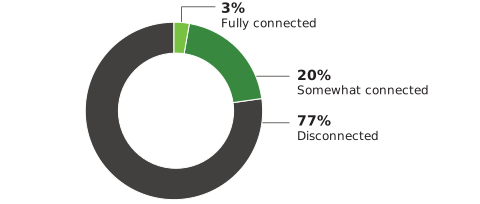
Source: The 2026 Fidelity Technology Integrations Pulse Survey
That’s not just an inconvenience; it’s a real problem across the industry. Advisors identify a lack of integration as their biggest challenge in using technology effectively.2
The relatively few firms with at least somewhat integrated tech stacks enjoy meaningful benefits, starting with ones you’d expect: enhanced scale and efficiency.1 Consider the client onboarding workflow. When onboarding clients, these integrators:
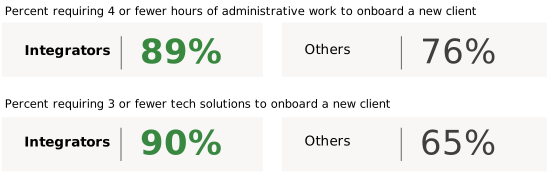

84% of integrators say their client onboarding solution meets their needs, compared with 31% of others.
But the benefits of better integration also extend beyond efficiency, impacting a firm’s relationships with their advisors and driving measurable business results.1
In fact, those who spend less time on administrative tasks and rely on fewer solutions when onboarding new clients are broadly more likely to be satisfied with their technology.1 And high technology satisfaction is tied to higher levels of integration and asset growth.1
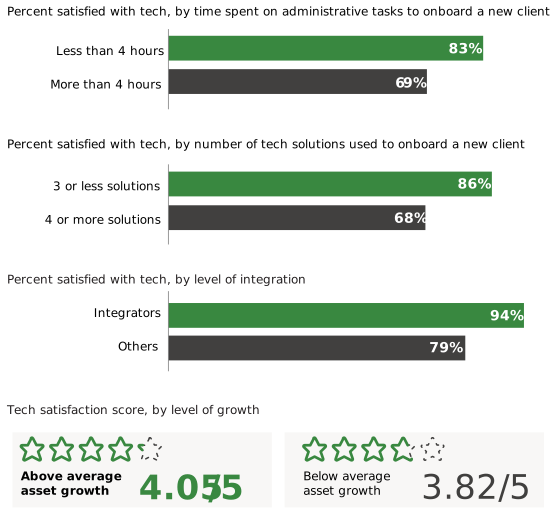
Source: The 2026 Fidelity Technology Integrations Pulse Survey
While most firms still have room for improvement in their efforts to meet today’s integration standards, those best practices—and the stakes to meet them—are also rising, thanks to two persistent factors:
Usage and integration of AI tools, by level of growth
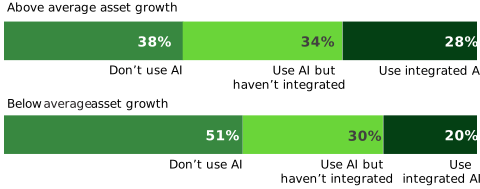
Source: The 2026 Fidelity Technology Integrations Pulse Survey
As tech stacks grow and AI becomes more embedded, the challenge shifts from connecting systems to ensuring the data flowing between them is consistent, accessible, and usable.
There is a ceiling to integration as we know it, and the industry is entering a new era in which a well-integrated tech stack is only as effective as the data layer underneath it. By focusing primarily on enabling workflows, many firms have not had to require that the data itself be aligned and governed across systems.
This next era isn’t just about doing the same work faster; it’s about doing fundamentally better, more intelligent work, including:
That all depends on more than workflow integrations; it requires trusted, well-managed data that flows consistently across the tech stack. And so, this next era of integrations will be defined not as a set of connected tools, but as a cohesive data environment that extracts business intelligence, powers better experiences, and results in better business outcomes.
Most firms have improved workflows. Few have made progress on holistic integration. Even fewer yet have fully addressed the data layer. And that’s what will separate incremental improvement from meaningful transformation.
Enhance your firm's efficiency while supporting clients at every stage with Fidelity's technology solutions.
Learn more
Explore new ways to streamline and accelerate your business growth with direct access to fintech integrations.
Learn more
Explore the award-winning organic growth platform designed to help you increase AUM through AI-powered lead data and insights.
Learn more



Endnotes
1. The 2026 Fidelity Technology Integrations Pulse Survey
2. Cerulli Associates - The Cerulli Report - State of U.S. Wealth Management Technology 2026
3. Orion, Advisor wealthtech survey, 2026
The 2026 Fidelity Technology Integrations Pulse Survey was an online client survey, conducted during the period of February 19 through March 30. It surveyed 270 wealth management industry professionals from RIA and Custody firms. Participants' roles include 78 advisors, 75 executives, 97 operations & support, 3 technology roles, and 17 other affiliated roles. The survey explored platforms and solutions used by respondent firms, their corresponding integration into their firm's larger technology stack, and related impacts on their business. Our analysis incorporated proprietary Fidelity platform data to classify responses. All asset growth figures are 3-year compound annual growth rates for assets under administration and custodied on Fidelity's platform.