You are on our wealth management services website for advisors & wealth managers.
Browse more Fidelity websites here.
The partial government shutdown that began on January 31 has now ended after President Trump signed a new funding bill into law. Most federal agencies are now fully funded through September 2026, with the exception of the Department of Homeland Security, which received temporary funding.
The most recent shutdown may be receding from headlines, but with another deadline already on the horizon, more funding debates are likely ahead. Here’s what to know about shutdowns and markets.
Shutdowns are hardly a rarity. As of the end of 2025 the government had faced a total of 11 shutdowns, starting with the first shutdowns in the early 1980s. History shows these shutdowns have ranged from very brief to more prolonged, but even the longer ones have had limited market impact.
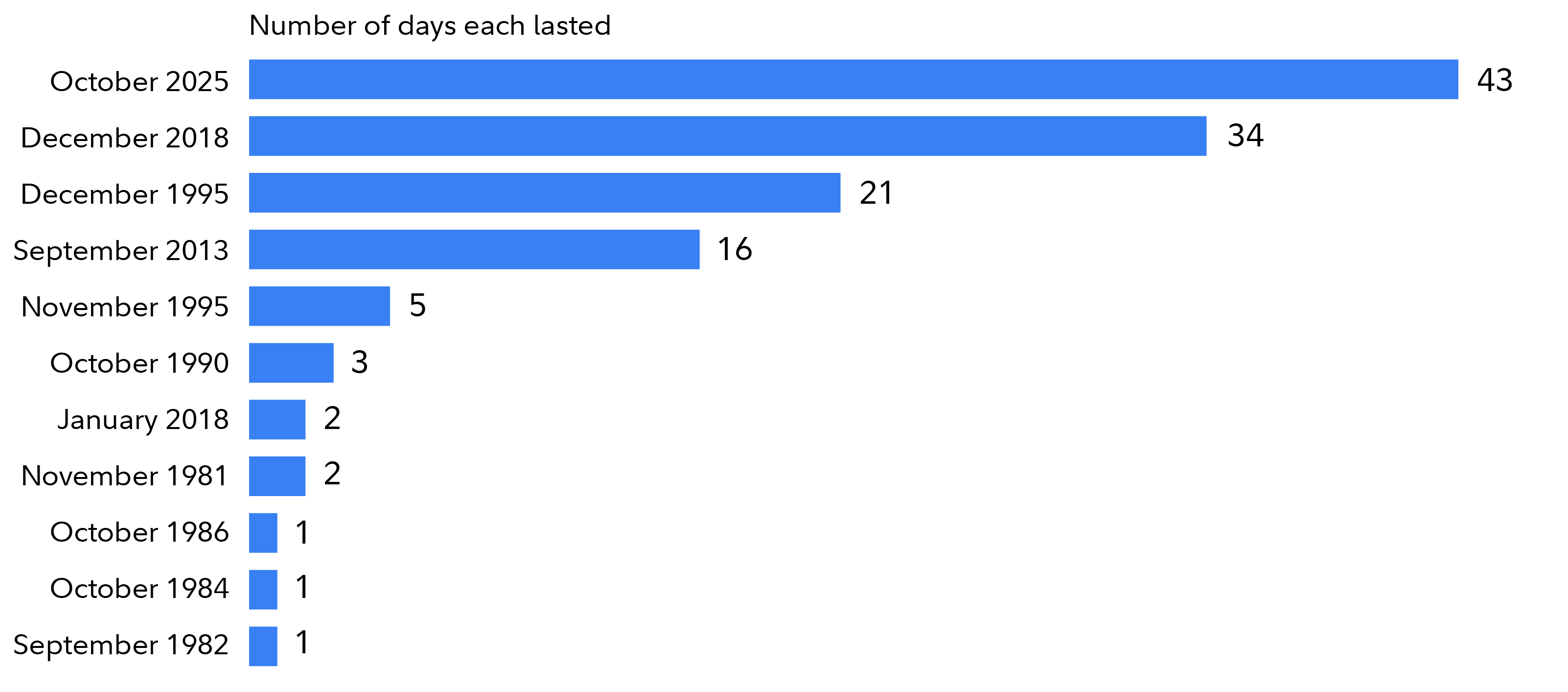
Source: US House of Representatives
Past shutdowns have had little impact on investors, consumers, or financial markets. “Even longer historical shutdowns, which were disruptive and costly, did not move the stock market,” says Jurrien Timmer, Fidelity's director of global macro.
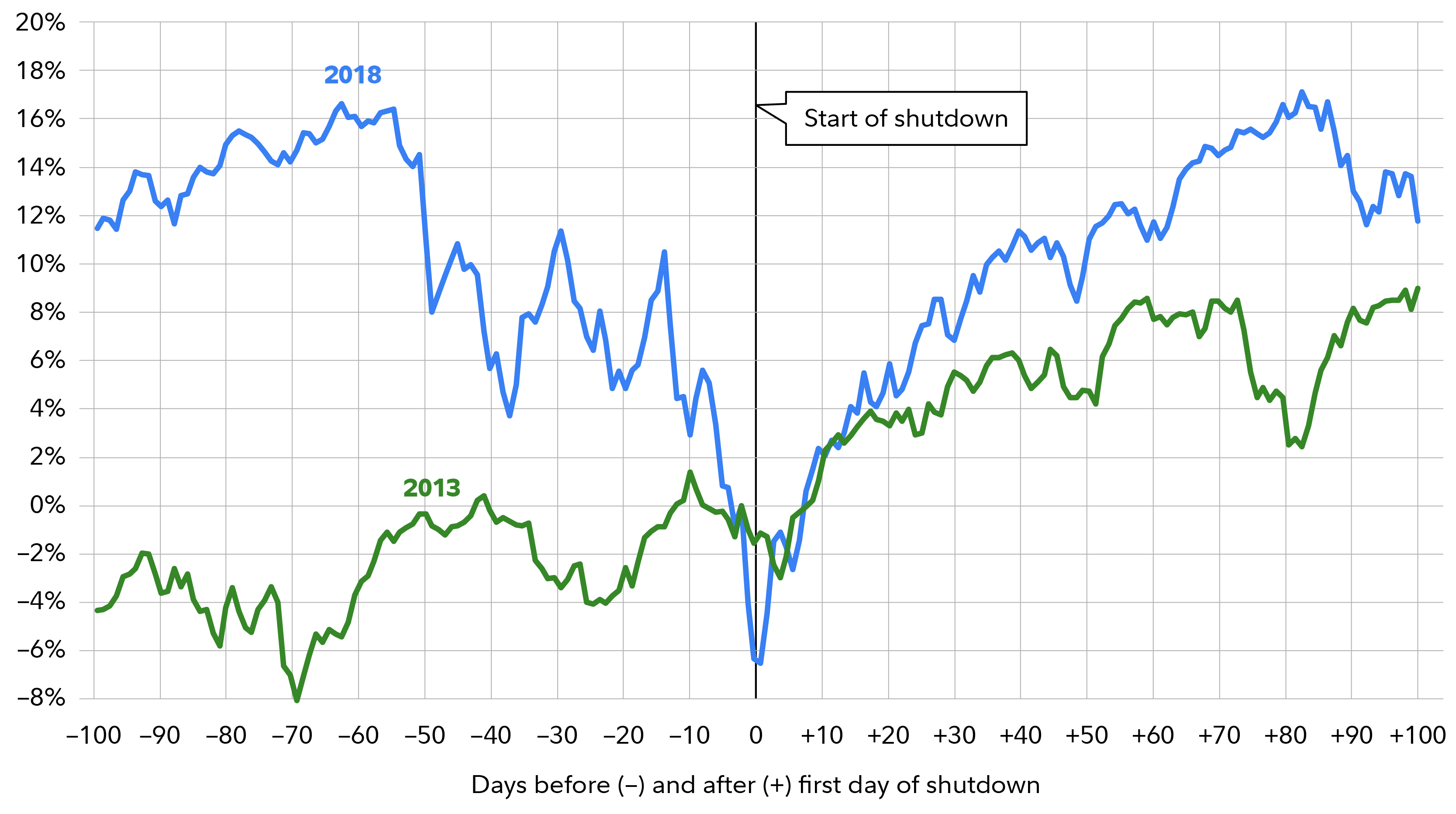
Timmer’s belief that shutdowns are not significant events for stocks is based on analyzing historical data about the performance of the S&P 500® Index during the 100 days before and after the 2013 and 2018 shutdowns. In both cases, stocks rose strongly in the 100 days following the shutdowns of nonessential government services.
Timmer also points out that the 2018 shutdown took place when stocks were nearing the tail end of what he calls an “unrelated 20% drawdown” and began a strong rally while the government was still on hiatus. And though past performance is never a guarantee of future results, US stocks generally rose over the course of the October to November 2025 shutdown.
What this history shows is that market participants understand that short-lived political maneuvering may make headlines, but typically does not have a meaningful impact on corporate earnings, which are the primary drivers of stock prices. That's especially true for news events such as a shutdown where the eventual outcome is predictable. As Timmer puts it, "We've all seen this movie before and it always ends the same way."
Sources: FMR, Bloomberg
While history shows that government shutdowns have had little long-term effect on stock prices—or on the size and functioning of the federal government—they can have a potential economic impact if they drag on.
The federal government spends enormous amounts of money buying goods, providing services, and otherwise generating economic activity. If a shutdown lasts for more than a short period, it can temporarily weigh on economic activity—primarily through reduced government spending and lower confidence among consumers and businesses.
For example, the 2025 government shutdown likely reduced US economic activity in the fourth quarter of 2025, though most estimates indicate that growth in gross domestic product (GDP) stayed positive despite the temporary drag.
A shutdown can cause an interruption of some government services but not all. Social Security, Medicaid, and Medicare payments to recipients generally are not affected. Neither are what are called essential services such as federal law enforcement, air traffic control, and disaster relief. The US Postal Service also generally is not affected.
While uncertainty about government shutdowns can generate worrisome headlines, the biggest risk for most investors may be the temptation to overreact to those headlines and make personal finance decisions based on fear and uncertainty.
Manage client portfolios with greater efficiency and impact with our broad universe of portfolio construction solutions and investment products.
Learn more
Drive efficiency and seamless digital experiences with Wealthscape's intuitive and flexible technology.
Learn more



This information is intended to be educational and is not tailored to the investment needs of any specific investor.