You are on our wealth management services website for advisors & wealth managers.
Browse more Fidelity websites here.
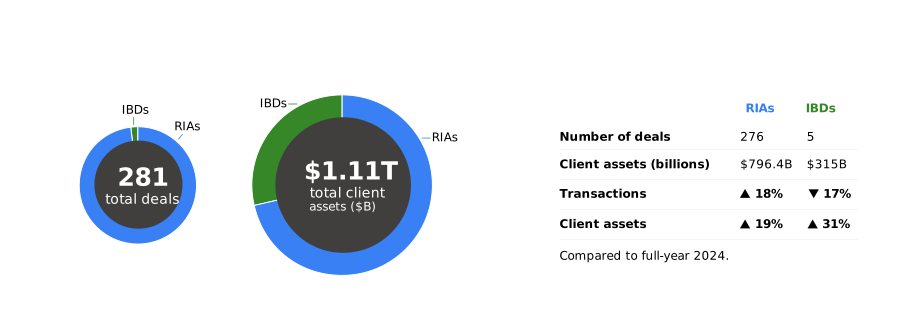
2025 set a new high-water mark for RIA M&A activity, with 276 completed transactions totaling $796.4 billion in purchased assets. This surpasses 2024’s 233 transactions and $669.8 billion in acquired assets. Notably, the record was broken early: the 234th transaction of the year in the M&A market was announced on October 31. And, for the first time since we began tracking the market in 2015, annual purchased assets exceeded three quarters of a trillion dollars, representing a 19% increase over the prior year and more than double the total recorded in 2023.
As we study the transactions, it's clear that firm leaders are not growing for growth's sake alone. Instead, firms are evolving into more sophisticated organizations as leaders recognize the imperative to “fish in bigger ponds in order to compete at scale.
This dynamic marks what we describe as Chapter Two of the industry's three-chapter M&A progression, a
framework first outlined in our Q1 2024 report. In this chapter, adjacency acquisitions such as tax planning,
CPA capabilities, and ultra-high-net-worth services, are becoming increasingly prominent as firms work to
build comprehensive fiduciary platforms. RIAs are shifting from a narrow focus on AUM acquisition to a more
strategic view of M&A as a tool for expanding and diversifying their service models.
This report explores the key statistics and structural trends shaping 2025’s record-setting M&A landscape. To illustrate how these dynamics are playing out in practice, the report also features a spotlight with Founder and CEO Marty Bicknell of Mariner, as well as a conversation with two leaders from Constellation Wealth Capital: Pat McHugh, managing director, head of Investments; and Mike Rieker, director, Advisory.
First, let's begin by examining the numbers.
Source: Fidelity compiled this data from public information.
Data covers the period from January 2018 through December 2025.
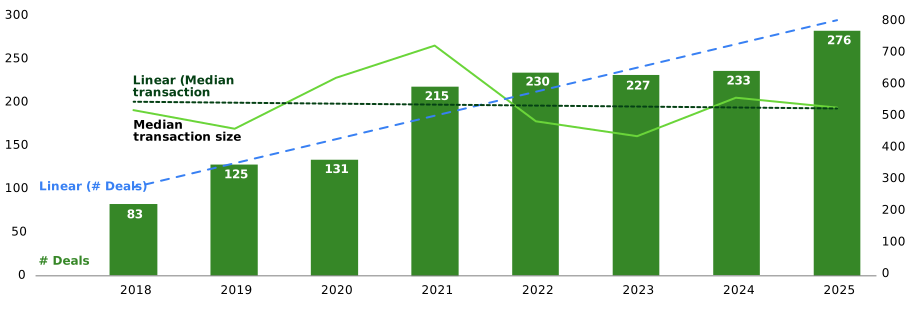
Since 2020, transaction volume rose 111%, while purchased assets grew more than fourfold. This momentum is clearly visible in the activity trendline, which mirrors the upward trajectory of the U.S. equity markets over the same period.
Despite an increase in total volume, median deal size has remained remarkably consistent, ranging from $400M–$600M. The exception is 2021, when near-zero interest rates fueled accelerated dealmaking amid a strong sense of FOMO (fear of missing out). This stability is reflected in the flat median trendline with 2025 finishing at a median deal size of $508 million
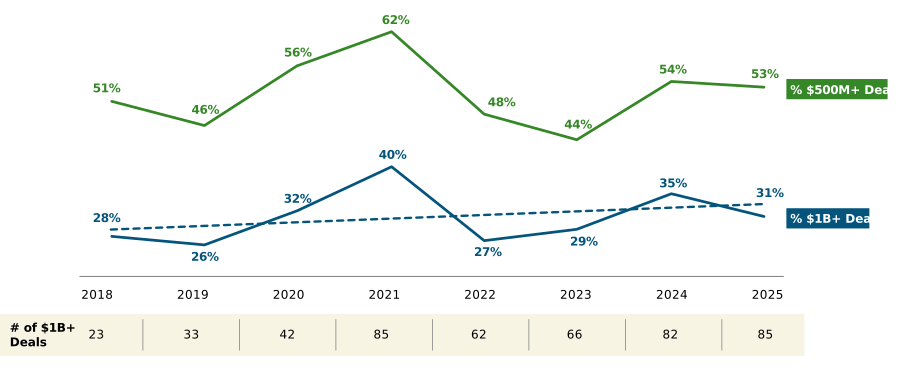
An examination of transactions involving more than $1 billion in purchased assets reveals a similar pattern. While quarter-to-quarter snapshots may suggest rising or declining activity at the $1 billion threshold, more than a decade of data provides a broader and more reliable perspective. The longer-term view makes it clear that the RIA M&A market remains durable and well-balanced, with steady demand across firms of all sizes, both above and below the $1 billion AUM mark.
Source: Fidelity M&A Reporting, which covers the period from January 2016 through December 2025, and Cerulli Associates U.S. Broker/Dealer Marketplace 2023.
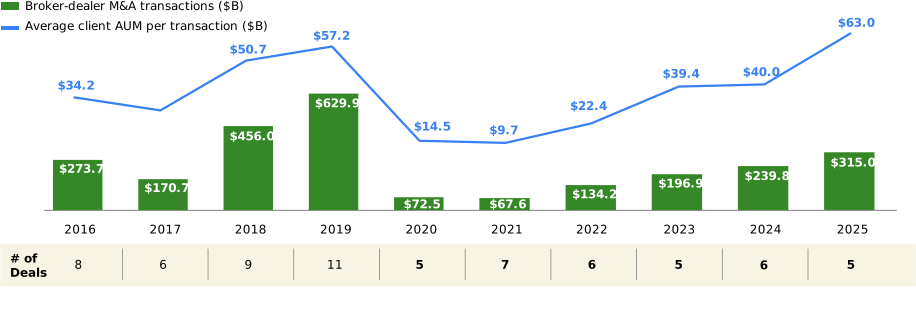
The more consolidated broker-dealer space yielded five M&A transactions totaling $315B in purchased assets. The broker-dealer sector s consolidated market structure, tighter capital obligations, and a rigorous regulatory environment continue to keep transaction activity relatively muted.
Why is the broker-dealer M&A market quieter than the RIA M&A marketplace?
The broker-dealer market is more concentrated as the number of broker-dealers continues to decline. According to FINRA,1 the 3378 broker-dealer firms in 2022 decreased to 3249 in 2024 (a 4% decrease), while Fidelity tracked 17 broker-dealer acquisitions during that time.
The broker-dealer landscape may continue trending toward consolidation as regulatory demands, technology expectations, and client needs become harder for smaller firms to shoulder on their own. Rising compliance requirements from FINRA, the SEC, and state regulators can consume staff time and resources, and larger firms may simply be better equipped with dedicated teams to handle that complexity. Technology is another pressure point: building or buying integrated, open-architecture platforms have become expensive, and bigger firms often have the resources to offer broader investment access and cleaner integration. Meanwhile, today’s clients expect a seamless, modern experience and advice that reaches into all corners of their financial lives; something that may require deeper tools, specialized talent, and a more robust platform. Layer these factors on top of the industry’s gradual shift toward advisory models, and you start to see why consolidation could remain a natural outcome.
Strategic acquirers announced 74% of the total transactions in 2025, up from 71% in 2024.
To gain deeper insight into the forces shaping dealmaking behavior, we narrowed our analysis to the top 20 most active acquirers, referred to throughout this report as the "Leading 20 Acquirer Cohort."
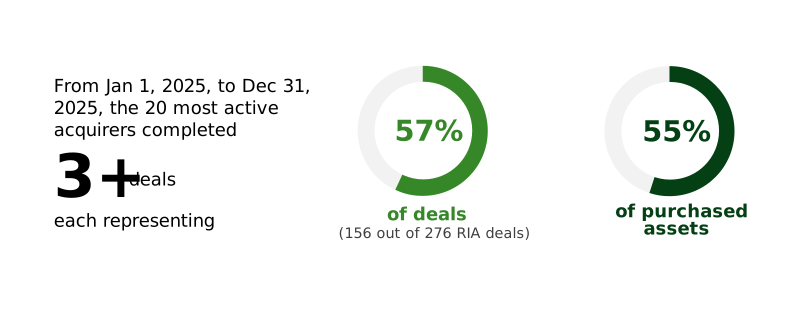
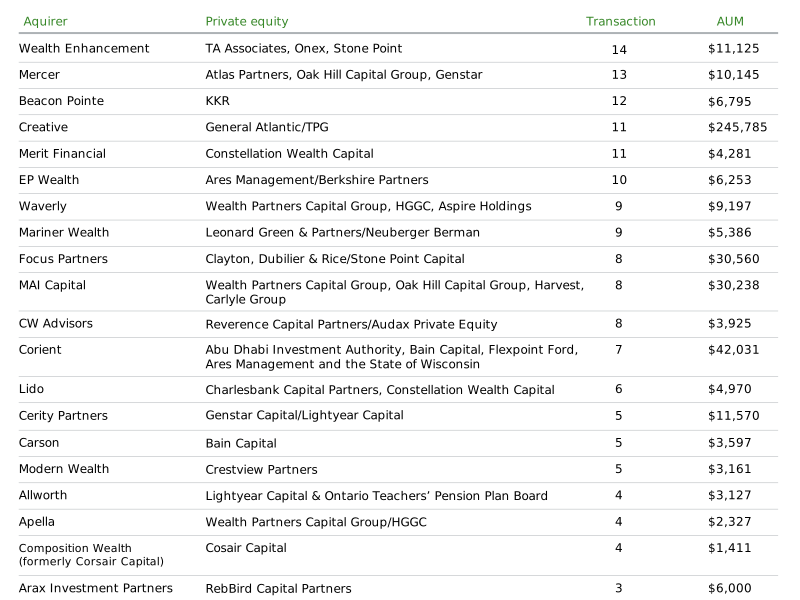
Source: Fidelity M&A Transaction Reporting. Fidelity compiled this data from public information. M&A activity from January 01, 2025, to December 31, 2025.
There are two forces driving this:
Force #1—The inward business alignment focus:
Following periods of high-volume or high-complexity acquisitions, many strategic buyers naturally shift inward, focusing on talent integration, operational alignment, and financial optimization. This recalibration is reflected in the cohort's composition in 2025. Six firms exited the cohort: CAPTRUST, OneDigital, Bluespring Wealth Partners, Diversify Wealth Management, Sequoia Advisors, and Robertson Stephens Wealth Management. Four of these remained acquisitive in 2025 but landed just outside the top 20. These exits were influenced by recapitalizations, complex or international transactions, and leadership changes. Six firms entered the cohort for 2025: Creative Planning, Mariner, CW Advisors, Apella Wealth, Composition Wealth, and Arax Investment Partners
Viewed over a decade, the shifting membership of the cohort reflects the natural rhythm of the M&A life cycle. These ebb and flow patterns indicate a healthy, dynamic marketplace in which firms rotate between phases of external expansion and internal consolidation.
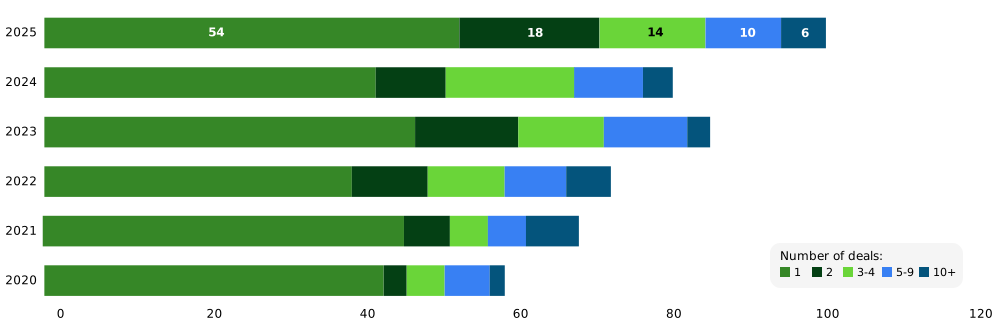
Source: Fidelity M&A Transaction Reporting. Fidelity compiled this data from public information. M&A activity from January 1, 2020, to December 31, 2025.
2025 outpaced all previous years with 102 buyers. 2023 and 2024 saw 87 and 82 buyers respectively. This year, a record 54 firms executed one deal, 18 firms executed two deals, and 30 firms announced at least three deals. Of these, six firms announced at least 10 deals. The 102 buyers included two banks, two broker-dealers, four PE firms, and three firms considered other such as a TAMP, investment consultant firm, etc. More buyers in the marketplace with record-setting deal volume diluted the share of deals executed by the Leading 20 Acquirer Cohort.
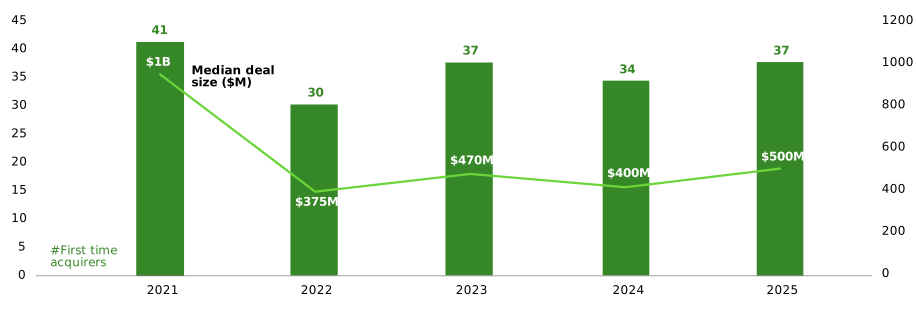
Source: Fidelity compiled this data from public information. Data for this report covers the period from January 2021 through December 2025.
Included in the total buyer count were 37 first-time buyers. While the count of debut dealmakers is not record-breaking, of these, it’s worth noting that three firms (Americana Partners, First Manhattan, and Maridea Wealth Management), two of which are backed by private equity firms, already went on to execute a second deal. It’s also worth noting that the $500 million median deal size transacted by first-time acquirers aligns to the median deal size of the broader marketplace.
As we explore strategic RIAs transitioning into full scale enterprises, we sought insight beyond our data by turning to a CEO who has navigated this very evolution, offering a grounded, real world perspective.
Mariner, a financial services firm with over $600B AUA2 led by CEO Marty Bicknell, began more aggressively incorporating inorganic growth into its strategy in 2017. Through numerous adjacent practice acquisitions, Bicknell remains anchored in Mariner’s mission to "positively impact the lives of many." As he puts it, "Mariner is growing, but not for growth’s sake. Our growth provides opportunities for personal and professional development and gives our advisors access to excellence in other areas for the benefit of the client."
Bicknell emphasizes that Mariner does not pursue a specific acquisition target number as part of its M&A strategy, nor is the firm operating with a “sprinter’s mentality.” Instead, it remains disciplined, generally closing 6-to-12 transactions every year after evaluating many more. Deals are guided by strategic fit, not volume, he says.
Mariner’s entry into adjacent business lines is driven by what Bicknell calls “front‑line needs.” He highlights the firm’s transformative 2025 acquisition of Woodbridge International, a boutique investment bank, which enabled Mariner to provide an in-house succession planning solution for business owners. To date, this service offering has already supported over two dozen clients, an outcome that Bicknell says surpassed his expectations greatly.
The firm’s overall integration philosophy follows a “front stage/backstage” approach: client-facing experiences remain unchanged, while back-office functions are streamlined to enhance efficiency without disruption.

“Culture is number one for us. Positively impacting the lives of many is not just a slogan; it’s real.”
As Mariner evolves into a more complex enterprise with multiple business units, governance and transparency have become increasingly essential. Bicknell stays deeply connected to the business through regular touchpoints, including bi‑weekly calls with business unit leaders, enabling him to quickly address cross‑functional needs spanning compliance, finance, and accounting.
For firms preparing to operate at enterprise scale, Bicknell says it’s imperative to have clarity around the desired client and advisor experience. Rather than focusing on size or structure, Bicknell urges firms to define the value they intend to deliver and to use that commitment as the lens for every strategic decision. Firm leaders must understand “what client value proposition and what advisor value proposition you’re striving for,” Bicknell says, and then remain disciplined in building an enterprise that fulfills those promises.
Additionally, Bicknell points out one of the industry’s emerging vulnerabilities: the lack of formal training and structured career paths for new advisors. Many firms still rely on informal shadowing models, which he warns will not keep pace with the wave of advisor retirements. “We’re going to have to have strong training and development programs inside our firms in order to keep up with the growth,” Bicknell says.
To help fuel Mariner’s growth, the firm accepted minority investments from Leonard Green & Partners in 2021 and Neuberger Berman in 2024. Bicknell describes both as exceptional partners, providing strategic capital while allowing Mariner to maintain operational autonomy in its M&A program. “Transparency and performance buy autonomy,” Bicknell says.
In 2025, private equity continued to fuel the RIA M&A landscape, backing 88% of total deals.
We spoke with two leaders at Constellation Wealth Capital: Pat McHugh, managing director, head of Investments, and Mike Rieker, director, Advisory, to get their thoughts on strategic capital in the M&A market.
Constellation Wealth Capital (CWC) is a private equity firm focused exclusively on minority, non-controlling investments in scaled, independent wealth management firms. Since launching its investment program in 2023, CWC has rapidly built a portfolio of 14 partner firms, ranging from $2B to $85B in AUM, with an emphasis on long‑term partnerships and tailored strategic support, while allowing the partner businesses to operate with autonomy.
“We are a minority partner by choice because these firms are continuing to build something truly exceptional. We want to be shoulder-to-shoulder with them.”
CWC stays aligned with its partner firms by tailoring its involvement to each firm’s growth model, maintaining daily communication, and earning influence through trust, not control. Some firms focus on M&A; others grow purely organically. CWC supports each approach directly, without forcing a one‑size‑fits‑all strategy.
Because the investments and advisory teams engage with firms every day, major decisions, especially transformative M&A, surface early. This mitigates surprises and allows both sides to shape the opportunity together rather than react to it after the fact.
CWC intentionally avoids exercising control over day‑to‑day operations to protect entrepreneurial independence. “We don’t have operational consent on every single thing,” McHugh says, “because the second that we become overbearing, you’re going to lose that autonomy and the independence that’s made the firm so special.”
That philosophy encourages partners to voluntarily involve CWC, creating alignment through credibility and trust rather than mandates.
CWC looks for partner firms with deep, high‑quality teams; a true ownership culture; and strong organic growth as the foundation for long‑term success. Organic growth is a top criterion because it signals a scalable model, a strong client value proposition, and a culture built around delivering exceptional service. Diversification across clients, advisors, and owners is also essential to help reduce concentration risk and ensure durability. The right firms are those that can “integrate businesses successfully, make advisors’ lives easier, and help them grow,” Rieker notes, which ultimately attracts both sellers and top talent to the platform.
CWC sees the definition of “wealth management” expanding to include additional services. They encourage firms to pursue adjacencies but only when aligned with client needs and long‑term strategic intent.
When asked what advice firms should follow to prepare for the next phase of complexity, McHugh stresses the importance of starting with absolute clarity on long‑term goals, and not just the deal math. Firms should align on their long-term vision and seek targeted advisor input before delving into options. “People can get very caught up in the transaction dynamics,” McHugh says, “and you really lose sight of the ultimate objective for the partnership.”
As for hurdles RIAs might face in building an enterprise model, he warns that leaders often underestimate the time and operational strain of a transaction. It can take up eighteen months, not three, for a successful transaction, and leaders who cut hiring to boost EBITDA may ultimately hurt growth and morale. Firms may be better off maintaining momentum, preparing financials, and setting a realistic timeline, McHugh states, that allows them to run the business while navigating the build‑out.
So where is the M&A landscape headed?
It appears that the market has yet to reach Chapter 3: the scale of “mega-mergers.” Bicknell sees a mega-merger in the RIA space as increasingly likely, fueled by significant private equity interest and the industry’s natural push toward larger fiduciary platforms. He notes that even the biggest RIAs remain small compared to legacy institutions with thousands of advisors, creating ample room for scale to expand within the independent model. “There’s no RIA that’s a large firm, and there will be,” Bicknell states. The combination of capital, consolidation momentum, and the strength of the fiduciary model, Bicknell believes, creates the conditions for a transformative deal to emerge in the near future.
McHugh says that the firms most likely to thrive and potentially help shape the industry’s next-generation RIA leaders will be those that enter capital or M&A discussions with real clarity about shared goals. He emphasizes that alignment will matter more than ever as deals get larger and more complex, advising firms to ask upfront, “If this goes well, what are you solving for?” to ensure both sides are building toward the same long-term vision. McHugh and Rieker also point to people as the defining engine of tomorrow’s scaled platforms; firms that invest in next-generation ownership, compensation, and development may be the ones best positioned to grow into (or become part of) the future mega-RIA the industry increasingly expects.
Suffice it to say, 2025’s M&A volume reflects more than record-breaking activity; it points to a structured demand for scale, specialization, and enterprise-ready platforms. Capital in strong supply, a widening amount of buyers, and sharpening strategic intent, suggest that demand is unlikely to meaningfully recede anytime soon. The question ahead is not whether M&A will continue, but which firms will be most deliberate in shaping what comes next.
Make the right move for your firm with our M&A resources, which can help you compete in an increasingly consolidated industry.
Learn more
Use our quick and easy RIA Valuation Tool to see how much you could earn if you're thinking of becoming a registered investment advisor.
Learn more
Discover how to transform your firm into a future-ready practice by leveraging our proprietary research, proven frameworks, and industry-leading insights.
Learn more



2 Fidelity compiled the data for this report from public information. Data for this report covers the period January 2025 through December 2025.
Unless otherwise noted, all data compiled in the report comes from Fidelity s M&A tracking research.
The acquirer models referenced herein are for illustrative purposes only and are not meant to be exhaustive of all business options or models a wealth management firm may consider for its particular situation.
The purpose of this report is to capture wealth management M&A deals involving:
If you are aware of a transaction that fits the criteria and is not listed in this report, please contact your Fidelity representative
The views expressed are as of the date indicated and may change based on market or other conditions. Unless otherwise noted, the opinions provided are those of the speaker or author, as applicable, and not necessarily those of Fidelity Investments. The experts are not employed by Fidelity but may receive compensation from Fidelity for their services. Fidelity Investments is not affiliated with any other company noted herein and doesn t endorse or promote any of their products or services. Please determine, based on your investment objectives, risk tolerance, and financial situation, which product or service is right for you.
Third-party trademarks and service marks are the property of their respective owners. All other trademarks and service marks are the property of FMR LLC or an affiliated company.