You are on our wealth management services website for advisors & wealth managers.
Browse more Fidelity websites here.
More than two-thirds of wealth management professionals are already using Generative AI, and users report a range of benefits.1 Yet the impact of AI adoption in this industry has fallen short of expectations, with nearly half of firms reporting an ROI of less than 3%.2
One might assume the right adjustment is to search for a better AI tool, but the truth is that the next best tool alone isn’t enough to make a real impact. Buy the sharpest model on the market, aim it at flawed data, and you get flawed answers faster, delivered with more confidence. That’s why access to adequate data is the top technological challenge to AI adoption among wealth and asset managers.2 And it’s why the World Economic Forum has called data readiness a strategic imperative for business.3
In the age of AI, when everyone has access to the same AI models, it’s a firm’s own data that enables them to apply those models to their business. And that makes AI-ready, propriety data a critical asset for today’s wealth managers.

In the race to use AI effectively, winning firms will have strong governance and clean data, not just good tools*
*EY-Parthenon, GenAI in Wealth & Asset Management Survey
While many may already have the data they need to make the most of AI tools, the value of a firm’s data can become locked in the course of their natural evolution over time. As firms grow and transform, events such as mergers, acquisitions, system migrations, and operating model changes can introduce inconsistencies across data sources, making it increasingly difficult to maintain a unified and reliable data foundation. And where a person may understand that fields like “client type” and “household category” refer to the same data point, an AI model may read them as unrelated facts.
In contrast, good, unlocked data is:
It’s important to note that, for almost all firms, maintaining good data is a work in progress. The goal isn't perfection everywhere. It's about developing AI data readiness where your strategy needs it most, rather than trying to tackle everything at once.
Many firms find themselves hampered by one or more common problems in their AI data readiness efforts. Consider these issues and how they may apply to your firm.

Client information is inconsistent across CRM, portfolio, and planning systems.

Prospecting tool and CRM are separate, and context drops upon conversion.

Documentation of client interactions is dispersed across email, Word, and CRM free-text.
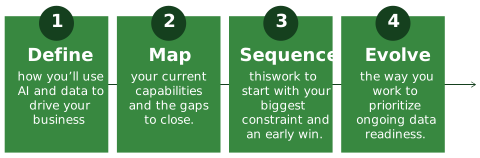
Data readiness for AI is a process, a priority, and an ongoing discipline. Firms that are ready to roll up their sleeves and get to work on this initiative can think about the work to unlock their data across four phases: Define, Map, Sequence, and Evolve. The first two phases require no new technology spend; so, any firm can start this work now. And it all begins with a vision and an honest assessment.
The AI advantage you’ve been looking for lives in data that you already own. Indeed, even the best AI engines can only take your business as far and fast as the data that fuels them.
This offers an opportunity for firms to secure a lasting, compounding advantage. As each new tool plugs into the same foundational data layer, every enhancement of that data elevates the full stack. This, in turn, raises the value of the data each tool generates.
The window to seize an advantage here is open. And though the benefits of this work will likely persist for many years to come, the chance to lead this rapid and profound industry transformation is fleeting.
Fidelity has significant expertise helping clients advance AI readiness. Our technology consultants work with wealth management firms to develop plans for strong data foundations, governance practices, and responsible AI usage. Reach out to your Fidelity representative to discuss next steps for your firm.

Enhance your firm's efficiency while supporting clients at every stage with Fidelity's technology solutions.
Learn more
Explore new ways to streamline and accelerate your business growth with direct access to fintech integrations.
Learn more
Explore the award-winning organic growth platform designed to help you increase AUM through AI-powered lead data and insights.
Learn more



1. The 2025 Fidelity AI Pulse Survey.
2. Publicis Sapient × ThoughtLab, The AI-Powered Investment Firm, December 2025.
3. World Economic Forum, "Why data readiness is now a strategic imperative for businesses," January 2026.
The 2025 Fidelity AI Pulse Survey was conducted during the period July 10, 2025, through August 11, 2025. It surveyed 730 wealth management industry professionals, including 189 advisors, 193 support and operations professionals, 137 RIA C-suite leaders (non-tech focus), 62 technology leaders/decision makers, 63 other leaders, 54 other affiliated roles, and 32 broker-dealer/home office professionals. The study explored utilization of generative artificial intelligence applications across various roles and functions within wealth management. Fidelity was identified as the sponsor and responses were collected via online survey by an independent firm not affiliated with Fidelity.
The third parties referenced herein are independent companies and are not affiliated with Fidelity Investments. Listing them does not suggest a recommendation or endorsement by Fidelity Investments.